Your dentist just told you that your cavity has “reached the dentin” and needs a bigger filling than expected. Or that bone levels look “reduced around the mesial of tooth #19.” Or that your root canal will need a post because there’s “not enough coronal structure remaining.”
None of this is meaningless jargon. Each term describes a specific anatomical layer, and which layer is affected determines exactly what treatment is needed — and what it’s going to cost.
Here’s what each part of the tooth actually does, and what happens to your bill when that part breaks down.
Enamel: The Hard Outer Shell
Enamel is the outermost layer of the tooth crown — the part you see above the gumline. It’s the hardest biological substance in the human body, harder than bone, composed of roughly 96% hydroxyapatite crystals (calcium phosphate mineral).
Critical properties:
- Contains no living cells — once formed, it can’t fully repair itself (though it can be partially remineralized)
- Has no nerve supply — enamel damage causes no pain
- Thickness varies: up to 2.5mm on molar chewing surfaces, thinner near the gumline
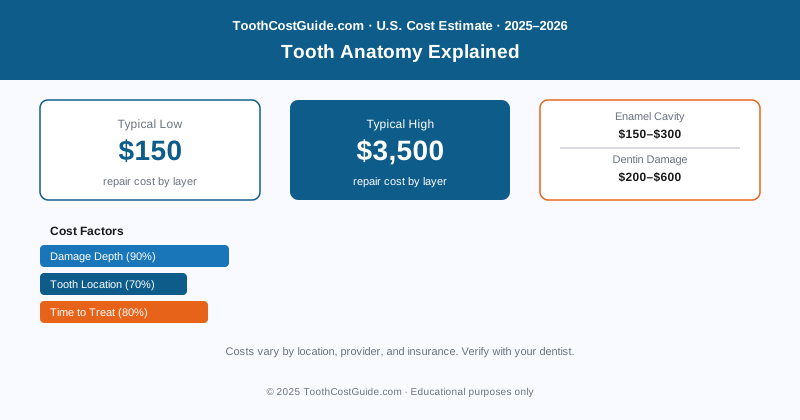
Why it matters for treatment cost: Enamel is the protective wrapper. A cavity confined entirely to enamel costs $150–$300 to fill. The removal is minimal, the filling is straightforward. But if enamel is lost to acid erosion (from soda or acid reflux) or grinding (bruxism), the dentin underneath gets exposed — and sensitivity, decay risk, and treatment costs all rise.
Enamel also responds to fluoride: fluoride chemically replaces some hydroxyapatite with fluorapatite, which is harder and more acid-resistant. This is why fluoride works — it’s basic chemistry.
Dentin: The Sensitive Middle Layer
Beneath enamel lies dentin — a pale yellow, calcified tissue that makes up the bulk of the tooth. It’s roughly 70% mineral, softer and more porous than enamel, and different in one critical way: it contains thousands of microscopic tubules running from the outer surface to the pulp.
Those tubules transmit fluid movement to the nerve inside. That’s why dentin exposure causes sensitivity — to cold, hot, sweet, and touch. The pulp nerve responds to fluid movement in the tubules.
Why it matters for treatment cost: Cavities in dentin are larger, progress faster (4–5x faster than enamel because it’s less mineralized), and cost more to fix. A two- or three-surface composite filling in dentin runs $200–$450. If decay is extensive, an inlay or onlay ($650–$1,200) may be needed because there’s not enough tooth structure remaining for a standard filling.
Dentin is also what makes older teeth look more yellow. As enamel thins over decades from wear and erosion, the more yellow dentin shows through — which is the main reason adults seek whitening.
Pulp: The Living Core
The pulp is the innermost tooth tissue — soft connective tissue containing blood vessels, nerves, and lymphatic vessels. It fills the pulp chamber in the crown and the root canals in the roots. Front teeth have a single canal; molars typically have three or four.
The pulp forms the dentin layer during tooth development, but in a fully mature tooth it’s less essential. An adult tooth can survive without its pulp — which is exactly what happens after root canal therapy.
Why it matters for treatment cost: Once decay or infection reaches the pulp, costs escalate sharply. Root canal therapy is needed: the pulp is removed, the canals are cleaned and shaped, filled with gutta-percha. Cost: $700–$1,500 depending on which tooth. A crown is almost always required afterward to protect the weakened structure: $1,000–$2,000. Total: $1,700–$3,500.
A tooth with reversible pulpitis — inflammation the pulp can still recover from — may be saved with a pulp cap, a protective dressing placed over the near-exposed pulp, at $75–$150. Once the pulp is irreversibly inflamed or dead (necrotic), root canal is the only option short of pulling the tooth.
Root canals are associated with severe pain — but that’s backwards. The pain before the procedure is from infected, inflamed pulp. The procedure itself, done with proper anesthesia, is comparable in discomfort to a filling. A 2016 study in the Journal of Endodontics found that patients who’d had root canals were six times more likely to describe the experience as “painless” than patients who’d never had one. The procedure relieves pain; it doesn’t cause it.
Cementum: The Root Covering
Cementum is a thin, calcified layer covering the tooth root below the gumline. It’s softer than enamel (similar in hardness to bone) and does one specific job: it anchors the fibers of the periodontal ligament to the root surface.
Unlike enamel, cementum is continuously deposited throughout life — which is how teeth stay anchored as jaw structure slowly changes over decades. It’s also why root surfaces are more vulnerable to cavities than enamel: cementum softens quickly when exposed to acid, and it gets exposed whenever gums recede.
Why it matters for treatment cost: Gum recession exposes cementum (and sometimes dentin) at the gumline — the cervical region. Root surface cavities here can be tricky to access and restore. They tend to be wider and shallower than conventional cavities. Treatment cost: $150–$350 for a composite filling, though some require restoration to extend slightly below the gumline, increasing complexity.
Periodontal Ligament: The Shock Absorber
The periodontal ligament (PDL) is a network of collagen fibers connecting the cementum on the root surface to the surrounding alveolar bone. It’s not just a passive anchor — it’s a living, active tissue that:
- Cushions the tooth against biting forces (biological shock absorber)
- Contains blood vessels and nerves
- Signals proprioception — the sensation that tells your brain how hard you’re biting
- Enables tooth movement (orthodontics works by compressing one side of the PDL, creating tension on the other, causing bone to remodel)
Why it matters for treatment cost: Periodontitis attacks the PDL. As bacteria and the body’s inflammatory response break down PDL fibers, the tooth loses attachment. That’s what pocket depth measures — the distance from the gumline to the bottom of the attachment. At 1–3mm, you have healthy PDL. At 6mm+, significant PDL and bone have been destroyed.
PDL damage is irreversible without surgical intervention (guided tissue regeneration). Even then, full regeneration is only partial. This is why periodontitis treatment — deep cleaning at $600–$1,200, surgery at $1,000–$3,000+ — costs so much more than treating gingivitis.
Alveolar Bone: The Foundation
The alveolar bone is the jawbone that surrounds and supports the tooth sockets. It’s the densest component of the periodontium and the foundation everything else rests on. When alveolar bone is lost — to periodontitis, infection, or tooth extraction — it doesn’t regrow naturally.
Why it matters for treatment cost: Bone loss is the defining feature of periodontitis severity. Moderate bone loss may require surgery. Severe bone loss can mean teeth can’t be saved. When a tooth is extracted and the socket is left alone, the surrounding bone resorbs (shrinks) over months — which is exactly why implants often require bone grafting ($200–$3,000 per site) if insufficient bone volume remains for implant placement.
Bone grafting at the time of extraction has become standard practice to preserve volume for future implant placement or aesthetics.
| Anatomical Layer | Damage Scenario | Treatment | Estimated Cost |
|---|---|---|---|
| Enamel | Small cavity (Stage 1–2) | Composite filling | $150–$300 |
| Dentin | Larger cavity (Stage 3) | Larger filling or onlay | $200–$1,200 |
| Pulp | Decay or abscess reaching nerve | Root canal + crown | $1,700–$3,500 |
| Cementum | Root surface cavity | Root surface composite | $150–$350 |
| Periodontal ligament | Periodontitis (Stage 3–4) | Deep cleaning or surgery | $600–$4,000+ |
| Alveolar bone | Severe bone loss or post-extraction | Bone graft + possible implant | $500–$5,000+ |
The Supporting Cast: Gingiva, Blood Supply, Nerves
Gingiva (gum tissue): The soft tissue collar around each tooth. Healthy gingiva is firm, pink, slightly stippled, and doesn’t bleed on gentle probing. It protects the underlying PDL and bone from bacterial invasion. Inflamed gingiva is the earliest stage of periodontal disease.
Blood supply: The pulp gets its blood supply through the apical foramen — a small opening at the root tip. When an abscess forms there, it’s called a periapical abscess. Deep cracks, trauma, and spreading infections can all cut off blood supply and cause a tooth to “die.”
Nerve supply: Sensory nerve fibers in the pulp (branches of the trigeminal nerve) signal pain, temperature, and pressure. Root canals remove these fibers — which is why a successfully root-canaled tooth no longer responds to cold testing.
Every line item on your dental treatment plan maps to a specific tissue, a specific problem, and a specific repair. When your dentist says “the decay is close to the pulp” or “we’re seeing horizontal bone loss on the X-ray,” you now know exactly what that means — and what’s coming next.