Six weeks. That’s how long it took for a patient’s mild cold sensitivity to turn into a $2,700 root canal and crown. She’d noticed something was off but figured it could wait until her next scheduled cleaning. By the time she sat in the chair, the decay had reached her pulp. What would have been a $200 filling was now a $1,500 root canal plus a $1,400 crown.
Tooth decay doesn’t announce itself with a fire alarm. It works through five distinct stages — and the treatment cost roughly doubles with each one.
Stage 1: Demineralization (White Spot Lesion)
This is the only stage where you can reverse the damage without drilling.
Acid-producing bacteria dissolve the mineral structure of enamel. The first visible sign is a chalky white or slightly opaque spot — a white spot lesion. The enamel surface is becoming porous, but it’s still structurally intact. No cavity yet.
How long this stage lasts: Weeks to months. With good hygiene and fluoride exposure, it can stay here indefinitely — or reverse entirely.
How to reverse it: Fluoride remineralizes enamel. Fluoride toothpaste, prescription fluoride gel (5,000 ppm), remineralizing agents like MI Paste, and cutting back on sugar all help. Your dentist can also apply in-office fluoride varnish.
Cost to treat: $0–$40 (fluoride varnish application). The ADA recommends fluoride varnish for at-risk patients, and that recommendation is backed by decades of clinical data.
Stage 1 demineralization is 100% reversible with fluoride — but only if caught. That’s why your dentist checks for white spots at every exam and why bitewing X-rays every 12–24 months matter so much. A white spot that gets remineralized costs nothing. Wait until it becomes a cavity and you’re looking at a minimum $150–$300 filling.
Stage 2: Enamel Decay
The surface has broken down. A true cavity now exists in the enamel layer. There’s still no pain — enamel has no nerve endings — which is exactly why people have no idea this is happening.
This is what dentists catch on X-rays and with their explorer instruments during routine exams. The decay is still entirely within enamel and hasn’t hit the dentin below.
How long this stage lasts: Months, sometimes longer. Enamel is dense and highly mineralized, so decay progresses more slowly here than anywhere else in the tooth.
Treatment: A composite (tooth-colored) or amalgam filling. Decayed material out, filling material in.
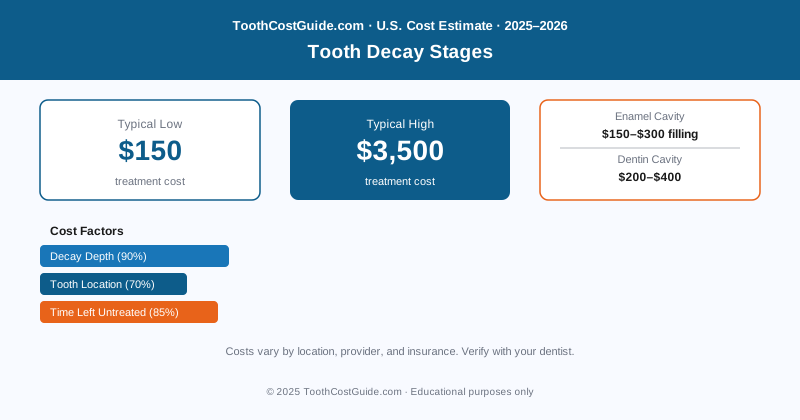
Cost: $150–$300 for a single-surface composite filling; $200–$400 for a larger two-surface filling. With insurance covering 80% of basic work, your out-of-pocket usually drops to $30–$80 after deductible.
Stage 3: Dentin Decay
Decay has pushed through enamel into dentin — the softer, yellowish layer underneath. Dentin contains microscopic tubules connected to the nerve. Now you start feeling it: sensitivity to sweet foods, cold drinks, or biting pressure.
Here’s what makes dentin so dangerous: it decays 4–5 times faster than enamel. Once you’re here, the clock speeds up significantly.
Treatment: Still a filling, but larger. If the decay is extensive, your dentist may place a protective base layer near the pulp. Some cases need an indirect pulp cap to keep bacteria away from the nerve.
Cost: $200–$450 for a two- or three-surface filling. Larger dentin cavities may need an onlay ($650–$1,200) if there’s not enough tooth structure left for a standard filling.
Stage 4: Pulp Involvement
Bacteria have reached the pulp — the inner chamber with nerves and blood vessels. This is where the classic toothache comes from: throbbing pain, heat sensitivity (not just cold), pain when biting. Sometimes bad enough to wake you up at night.
Treatment: Root canal therapy. The infected pulp is removed, the canals are cleaned and shaped, then filled with a rubber-like material called gutta-percha. A crown is almost always needed afterward to protect what’s left of the tooth.
Cost: Root canal alone: $700–$1,500 depending on which tooth (front teeth have one canal; molars have three or four). Crown: $1,000–$2,000. Total: $1,700–$3,500 per tooth.
| Stage | Condition | Treatment | Estimated Cost |
|---|---|---|---|
| Stage 1 | Demineralization (white spot) | Fluoride / remineralization | $0–$40 |
| Stage 2 | Enamel cavity | Composite filling | $150–$300 |
| Stage 3 | Dentin cavity | Larger filling or onlay | $200–$1,200 |
| Stage 4 | Pulp involvement | Root canal + crown | $1,700–$3,500 |
| Stage 5 | Abscess / tooth loss | Extraction + implant (or bridge) | $2,500–$6,000+ |
Stage 5: Abscess and Tooth Loss
Untreated pulp infection spreads into the surrounding bone and soft tissue, forming a periapical abscess — a pocket of pus at the root tip. The tooth may become impossible to save.
Symptoms: severe throbbing pain, visible swelling, facial swelling, fever, pus drainage, a persistent foul taste. In extreme cases, the infection spreads to the jaw, neck, or airway — a genuine life-threatening emergency.
Treatment options: If the tooth can still be saved, root canal + crown. If not, extraction ($200–$600) followed by replacement: dental implant ($3,000–$5,000), bridge ($3,000–$6,000 for three units), or removable partial denture ($1,500–$2,500).
Cost: $2,500–$6,000+ depending on extraction and replacement needs.
How Fast Does Decay Progress?
Honestly, it varies. Diet, saliva quality, fluoride exposure, and how well you clean your teeth all play a role.
Research in the Journal of Dental Research found that the average time for a lesion to progress from enamel into dentin in permanent teeth was roughly 3 years in low-risk patients — but as fast as 6–12 months in high-risk individuals with high sugar intake, dry mouth, or poor hygiene.
Kids and adults who take medications that reduce saliva flow progress faster. Older adults with receding gums develop root cavities quickly because cementum — the root surface material — is much softer than enamel.
Why X-Rays Catch What Eyes Miss
About 40% of cavities form between teeth, in the contact areas no mirror or probe can reach. Bitewing X-rays are specifically designed to catch these interproximal cavities at Stage 2 or 3, before they become root canals.
The ADA recommends bitewing X-rays every 12–24 months for adults at average risk. At $50–$150 per set without insurance (usually free with coverage), they’re the most cost-effective diagnostic tool in dentistry.
Cold sensitivity that lingers more than a few seconds after removing the cold stimulus is a red flag. Normal teeth zing briefly and recover. A tooth where sensitivity hangs around 10–30 seconds after the cold is gone may have decay close to or already in the pulp — and needs evaluation before it progresses to irreversible pulpitis requiring a root canal.
The Bottom Line on Cost Escalation
The math is simple. Catching decay at Stage 1 costs nothing if fluoride reverses it. Stage 2 is $150–$300. By Stage 4, you’re at $1,700–$3,500. Stage 5 can exceed $6,000 for the full treatment cycle.
Two cleanings and exams per year — roughly $300–$500 without insurance — are the mechanism that catches Stage 1 and 2 cavities before they get expensive. It’s not generic dental advice. It’s the most cost-effective decision most dental patients can make.