Myth: All wisdom teeth need to come out.
False. A 2020 systematic review in the Journal of Oral and Maxillofacial Surgery found no strong evidence that prophylactic removal of asymptomatic, cavity-free, fully erupted wisdom teeth provides net benefit. The American Association of Oral and Maxillofacial Surgeons (AAOMS) recommends removal when there’s clinical indication — not as a universal rule.
About 35% of people never develop wisdom teeth at all. Of those who do, a meaningful percentage erupt fully, function normally, and never cause problems. The real question isn’t “when do wisdom teeth need to come out?” It’s “does this wisdom tooth, in this patient, have an actual problem?”
Here’s how to answer that — and what the surgery costs.
What Wisdom Teeth Are and Why They Cause Problems
Wisdom teeth are your third molars — the last teeth to develop, typically coming in between ages 17 and 25. Most adults have four, one in each corner of the mouth.
The problem isn’t the teeth themselves. It’s that modern human jaws, shaped by generations of softer diets and genetic variation, are often too small to accommodate them. When there’s not enough room, wisdom teeth become impacted — they can’t fully erupt through the gumline.
Types of impaction:
- Mesial (angular) impaction: The tooth angles forward toward the second molar. Most common, and often most problematic — the tooth presses against the adjacent molar.
- Vertical impaction: Upright but blocked by the second molar or bone. Often easier to extract than angular cases.
- Horizontal impaction: The tooth lies completely sideways, pointing directly at the roots of the second molar. Typically the most complex surgical case.
- Distal impaction: Angled backward, away from the second molar. Less common and often causes fewer immediate problems.
Why impaction matters: Partially erupted teeth create a gap between the gum flap and tooth where food and bacteria accumulate. This leads to pericoronitis — infection of the tissue around the crown — which is one of the most common reasons patients end up needing emergency wisdom tooth removal.
When Removal IS Recommended
Active infection (pericoronitis): Recurring infection, swelling, pain, or trismus (difficulty opening the mouth) around a partially erupted tooth. One of the clearest indications.
Cavities: If the wisdom tooth itself has decay that can’t be properly restored given its position — or if it’s causing a cavity on the back of the adjacent second molar — removal makes sense. Upper wisdom teeth are notorious for causing hard-to-treat decay on the second molar right beside them.
Cysts: Impacted wisdom teeth can develop dentigerous cysts around their crown, which expand and destroy surrounding bone. Both tooth and cyst must be removed.
Damage to adjacent teeth: If the wisdom tooth is dissolving (resorbing) the roots of the neighboring second molar, removal is indicated.
Periodontitis around the area: Impacted wisdom teeth make thorough cleaning impossible. Deep pockets behind second molars are notoriously difficult to treat when a wisdom tooth is blocking access.
Before orthodontic treatment (sometimes): Orthodontists occasionally recommend removal before or during treatment. Worth noting: the evidence that wisdom teeth actually cause crowding is weaker than commonly believed.
When Monitoring Is a Reasonable Choice
Fully erupted, functional wisdom teeth with no decay, no cysts, and no damage to adjacent teeth don’t necessarily need extraction. Annual X-ray monitoring is a legitimate approach for asymptomatic, healthy wisdom teeth.
The British National Institute for Health and Care Excellence (NICE) formally recommends against removing asymptomatic impacted wisdom teeth. AAOMS takes a more interventionist position, citing future complication risk — particularly in older patients where surgery carries greater risk.
The honest answer: if your wisdom tooth is asymptomatic, cavity-free, and not damaging anything nearby, ask your dentist to explain specifically why they’re recommending removal. “It might cause problems later” is valid — but it’s not an absolute reason, and you deserve a direct answer.
Types of Extraction and Difficulty
Simple erupted extraction: Tooth is fully visible above the gumline. A general dentist can usually handle this with local anesthesia. Similar to any other molar extraction.
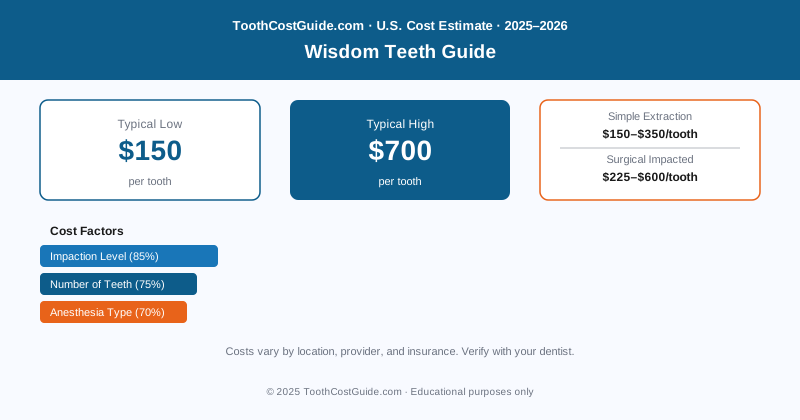
Surgical extraction of impacted tooth: Requires an incision, possibly removing bone to access the tooth, and sectioning the tooth into pieces for removal. Almost always performed by an oral surgeon, though experienced general dentists do some of these.
The depth of impaction, the angle, root anatomy, and proximity to the inferior alveolar nerve all affect complexity and price.
| Extraction Type | Per Tooth | All Four (Estimate) | Notes |
|---|---|---|---|
| Simple (fully erupted) | $150–$350 | $600–$1,400 | General dentist or oral surgeon |
| Surgical (soft tissue impaction) | $225–$400 | $900–$1,600 | Minor incision required |
| Surgical (partial bony impaction) | $275–$500 | $1,100–$2,000 | More bone removal |
| Surgical (full bony impaction) | $350–$600 | $1,400–$2,400 | Most complex |
| IV sedation or general anesthesia | +$400–$800 | Add to above | Optional; strongly recommended for complex cases |
Insurance Coverage
Wisdom tooth removal typically falls under the “basic” or “surgical” benefit — usually covered at 80% after your deductible, up to your annual maximum.
For four impacted wisdom teeth with general anesthesia, total fees might run $2,000–$3,200. Insurance might cover $1,000–$1,500 of that (hitting the annual cap). Your out-of-pocket: $1,000–$2,200 depending on your plan.
If you’re under 26 and on a parent’s plan, or if your employer’s plan has a $2,000 maximum, it may be worth splitting extractions across two calendar years to use two years’ worth of benefits.
The 72-Hour Recovery Window
Wisdom tooth recovery has two phases: the critical first 72 hours and the full healing period.
Hours 0–72: This is when dry socket risk peaks. Dry socket — when the blood clot dislodges before the site heals — affects 2–5% of extractions overall and up to 20% of lower third molar cases. It causes intense throbbing pain starting 3–5 days after surgery.
To prevent dry socket during the first 72 hours:
- No smoking
- No straws, spitting, or vigorous rinsing
- Soft foods only (yogurt, mashed potatoes, smoothies without straws)
- Keep gauze on the site as directed
Days 3–7: Swelling peaks around day 2–3 and gradually resolves. Ice packs the first 24 hours, then warm compresses. Most patients can eat soft foods normally by day 5–7.
Full healing: The socket takes 3–6 months to fill completely with bone. Most patients feel normal within 1–2 weeks.
Most oral surgeons recommend removing all four at one surgery if all four need to come out — one recovery, one round of anesthesia costs, one time off work. The exception: if only one or two are problematic and the others are healthy and erupted, there’s no reason to remove the healthy ones preemptively. Ask your surgeon directly: “Are you recommending removal of all four because they’re all currently problematic, or is this preventive?” That answer shapes the decision.
Age and Risk: Does Timing Matter?
Yes, it does. Younger patients (17–25) typically have better outcomes because:
- Roots aren’t fully formed yet, making extraction technically easier
- Bone is less dense, reducing surgical difficulty
- Healing is faster
- The inferior alveolar nerve is generally farther from the root tips
After 35, complications including nerve injury, dry socket, delayed healing, and infection become more common. That doesn’t mean older patients shouldn’t remove problematic wisdom teeth — they absolutely should — but it’s a reason not to let symptomatic teeth linger.
If your dentist has been monitoring asymptomatic impacted wisdom teeth for years and nothing is changing, continued monitoring is reasonable. If problems develop, address them sooner rather than later.